2026-11-05 ·
Tankless vs Traditional Water Heaters for New Mexico Homes
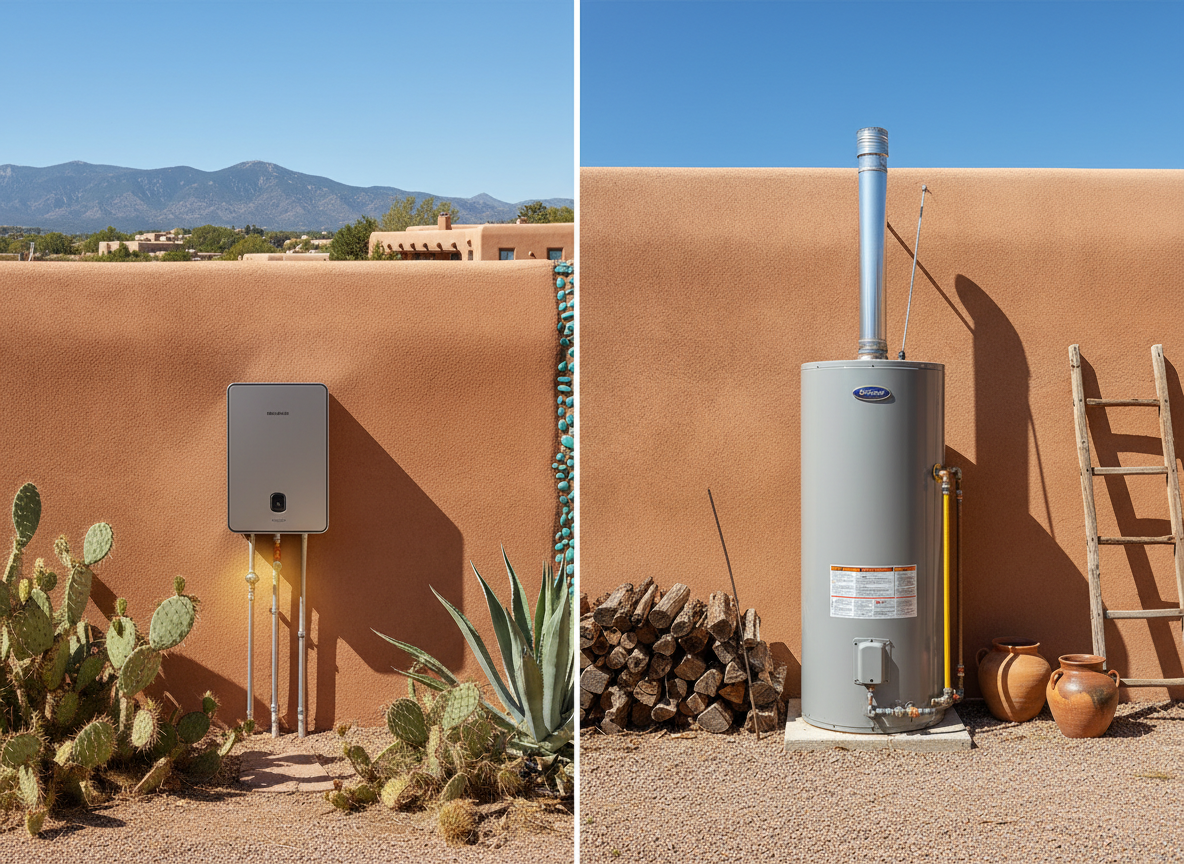
In Santa Fe homes, traditional tank water heaters typically deliver reliable daily performance for 8–12 years while tankless models can reach 20 years when properly sized and protected from cold snaps, though both require attention to the area's high desert freeze cycles and older pipe layouts in neighborhoods like the Eastside and Downtown.
Traditional Tank Water Heaters
Traditional 40- to 50-gallon tanks dominate Santa Fe County homes built before 1990, especially along Canyon Road and near the Palace of the Governors where space under stairs or in small utility rooms favors compact upright units. These systems store heated water and recover slowly after heavy use, which suits single-bathroom houses common in the Railyard District but can run short during simultaneous showers in larger Eastside properties. Cold winter nights drop below freezing, so many owners keep the tank thermostat at 120°F and add insulation blankets to prevent standby heat loss. Sediment from local hard water builds faster here than in Albuquerque, shortening element life unless flushed twice a year. When leaks appear around the base or recovery times stretch beyond 45 minutes, water heater repair restores function without full replacement in most cases.
Tankless Water Heaters
Tankless units heat water on demand and eliminate standby losses, yet they demand adequate gas line capacity and freeze protection that older Santa Fe homes often lack. In the high desert climate, outdoor models need heat trace cables and indoor units require dedicated space away from unheated crawl spaces common in Canyon Road adobes. Flow rates of 5–8 gallons per minute handle two simultaneous fixtures but struggle with three during peak winter mornings when inlet water sits at 35–40°F. Proper venting through existing chimneys or sidewall terminations adds complexity in historic Downtown structures. Homeowners considering an upgrade often start with a load calculation that accounts for elevation and incoming groundwater temperature rather than simply matching the old tank's gallon rating.
Climate and Housing Factors in Santa Fe County
Santa Fe's cool summers and cold winters create distinct demands on water heating equipment compared with nearby Albuquerque or Rio Rancho. Nighttime lows in December and January frequently reach single digits, forcing installers to route recirculation lines or add antifreeze loops on tankless units to avoid burst heat exchangers. Adobe and older frame homes on the Eastside often have galvanized or copper supply lines that restrict flow, reducing the effective output of high-GPM tankless models. Soil conditions around the Plaza and Georgia O'Keeffe Museum area tend toward alkaline, accelerating corrosion on tank bottoms when condensate drains are not routed correctly. These realities favor keeping a traditional tank in many pre-1970 properties while new construction in Eldorado at Santa Fe or Agua Fria can accommodate tankless with proper gas sizing from the outset.
Installation and Long-Term Considerations
Switching from tank to tankless in Santa Fe County usually requires upsizing the gas line to 3/4-inch or larger and adding a condensate drain, steps that increase project scope beyond simple swap-outs. Traditional tanks fit existing 120-volt outlets and standard venting, keeping changeover costs lower for homes near Santa Fe Opera or Tesuque. Hard water scale affects both types but hits tankless heat exchangers harder, making annual descaling advisable; readers facing ongoing mineral issues can review hard water problems in Santa Fe for early warning signs. Professional sizing that factors local winter inlet temperatures prevents the short-cycling common when oversized tankless units serve small households. For properties in Pojoaque or Chimayo with limited utility access, traditional tanks remain simpler to service with widely available parts.
Making the Right Choice for Your Home
Evaluate your household's simultaneous hot-water demand, existing gas infrastructure, and willingness to perform seasonal freeze protection before deciding between the two systems. Homes in the Railyard District with steady occupancy often benefit from the efficiency gains of tankless once gas lines are updated, while seasonal or smaller Eastside residences continue to rely on traditional tanks for simplicity and lower upfront cost. When either unit shows declining performance, water heater installation teams familiar with Santa Fe County conditions can assess whether repair or full replacement better matches the property's layout and future plans.